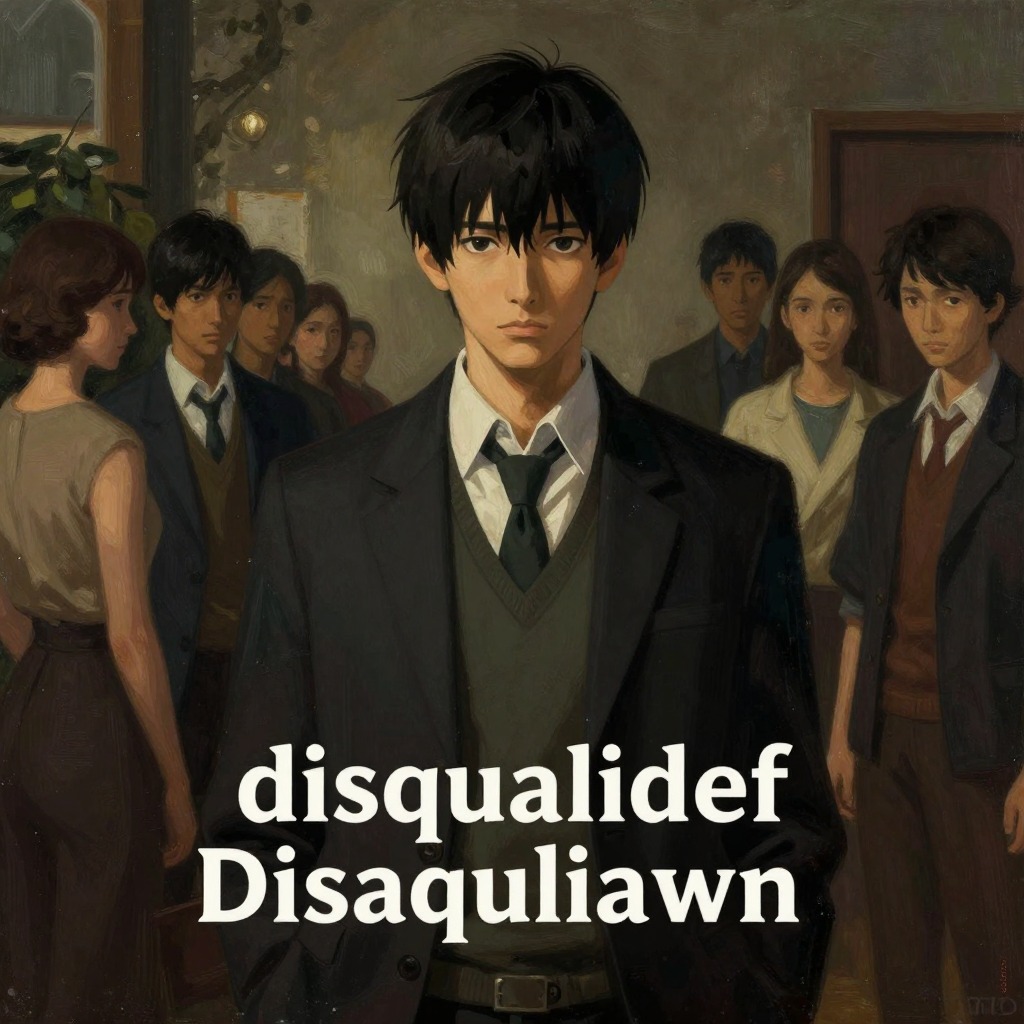
Criminal consciousness
Criminal consciousness is the internalized, lifelong sense of guilt and unworthiness that defines Yozo's existence in No Longer Human. Unlike a legal status or a social label, it is a subjective, almost metaphysical wound that appears in infancy and deepens with time, becoming more precious to him than his own flesh and blood. This consciousness is not the result of any single crime but a fundamental orientation toward the world, a conviction that he is inherently flawed and that his very being constitutes a transgression. It is the lens through which he interprets his own actions and the actions of others, and it ultimately leads him to declare himself "disqualified as a human being."
Origins and Early Manifestation
Yozo describes his criminal consciousness as a wound that appeared of itself when he was an infant, a wound that, far from healing, grew only deeper with the passage of time until it reached the bone. He characterizes the agonies he suffered night after night as a hell composed of an infinite diversity of tortures, yet paradoxically, the wound became dearer to him than his own flesh and blood; he thought its pain to be the emotion of the wound as it lived, or even its murmur of affection. This suggests that the criminal consciousness is not merely a source of suffering but a core component of his identity, a familiar and even cherished companion. He explicitly compares it to a wife in poverty, with whom he indulged in forlorn pleasures, indicating that this sense of guilt is a constant, intimate presence that shapes his solitary existence.
The Antonym of Crime and the Nature of Guilt
Yozo's obsession with the nature of crime and punishment reaches its peak during a drunken game with Masao Horiki. When Horiki flatly states that the antonym of crime is "the law," Yozo is shaken to the core, feeling that Horiki's face, caught in the flashing red light of a neon sign, had the somber dignity of a relentless prosecutor. Yozo rejects this simplistic equation, arguing that virtue and vice are concepts invented by human beings, a morality arbitrarily devised, while crime belongs in a different category. He grapples with the idea that the antonym of crime might be God, salvation, love, or light, but each pairing—God and Satan, salvation and perdition—seems to him a synonym rather than an opposite. The thought of Dostoevsky's Crime and Punishment grazes his mind, and he wonders if the author ranged "crime" and "punishment" not as synonyms but as antonyms, absolutely incompatible ideas, irreconcilable as oil and water. This intellectual struggle reveals that Yozo's criminal consciousness is not about legal transgression but about a metaphysical condition that cannot be resolved by any external system of justice.
The Wound of Guilt and the Inability to Resist
Yozo's criminal consciousness is inextricably linked to his inability to resist or contradict others. He notes that he has never once desired to kill anybody, thinking that in killing a dreaded adversary he might actually be bringing him happiness. This passivity extends to his acceptance of blame: when Horiki accuses him of causing women to die and lifting money from them, a voice of weak resistance speaks from somewhere in Yozo's heart, saying that he had not caused anyone to die and had not lifted money from anyone. Yet, the ingrained habit of considering himself evil takes command, and he cannot contradict Horiki to his face. This pattern of accepting guilt, even when it is not warranted, is a direct consequence of his criminal consciousness. It is a wound that throbs with pain whenever he comes in contact with a human being, a wound that was split through his forehead between the eyebrows after Yoshiko's violation, an event that made him lose all confidence in himself and doubt all men immeasurably.
The Final Rejection and the Loss of Self
The culmination of Yozo's criminal consciousness is his confinement in a mental hospital. He reflects that he is no longer a criminal but a lunatic, yet he insists he was never mad for even an instant. He recognizes the social logic: people who get put into an asylum are crazy, and those who don't are normal. His cry, "God, I ask you, is non-resistance a sin?" encapsulates the paradox of his existence. His criminal consciousness, which has been his constant companion, has led him to a state where he has ceased utterly to be a human being. The news of his father's death eviscerates him, and he feels as though the vessel of his suffering has become empty, as if nothing could interest him now. He has lost even the ability to suffer. In the epilogue, the Madam of the Kyobashi bar, who knew him, describes him as "a good boy, an angel," a stark contrast to Yozo's own self-perception as a mass of vices. This final judgment underscores the tragic gap between Yozo's internal criminal consciousness and the external perception of his character, revealing that his deepest wound is invisible to others.